Showing posts with label review. Show all posts

Wednesday, October 25, 2017

The Bad-Ass Librarians of Timbuktu


While some may describe the title of Joshua Hammer’s latest book as sophomoric and overwrought, as a librarian (once described by a former professor as “smart ass”) and with my background in art history specializing in medieval manuscripts, the title of the book had me at the get-go. I was further intrigued by the setting: Timbuktu – that faraway, forsaken place where my mom threatened to send me when I misbehaved. Was Timbuktu a real place?  

Once I opened the book, I learned that Timbuktu is indeed a very real place named for a woman called Bouctu, “one with the big belly button,” referring to the watering hole 20 km north of the Niger River in the country of Mali. In the 15th and 16th centuries during its Golden Age, Timbuktu flourished not only as an important commercial center, but also as the intellectual hub of the sub-Saharian world, where Islamic scribes copied surveys of mathematics, science, medicine, and astronomy as well as religion and philosophical texts. Africa traded slaves, spices and gold with Europeans for tea and cloth. The history of Timbuktu fluctuated between periods of prosperity and peace with those of intolerance and repression.

In the modern age, Timbuktu was making a comeback as a cultural center as one man, Abdul Kader Haidera, recovered nearly 377,000 manuscripts held mostly by private families and instituted a national library to secure them. The region also held international music festivals attracting famous musicians. Through Haidera’s unique vision and with the aid of a band of librarians, these precious manuscripts were smuggled out of Timbuktu - right under the noses of the jihadists who invaded northern Africa after the Libyan defeat of Qualdafi. 

While the book could have included visual illustrations, such as a detailed map and photographs of some of the manuscripts, the cloak and dagger operation, nonetheless, is packed full of palpable detail, also describing the region’s struggle to rid itself of rebels, colonialists, and extremists. For me, this journalistic account was an eye-opener. Why did the mainstream media not highlight the atrocities in Northern Africa? This vexing question resonates today as we are only beginning to be told about the occurrences in neighboring Niger.

~Barb

Thursday, July 13, 2017

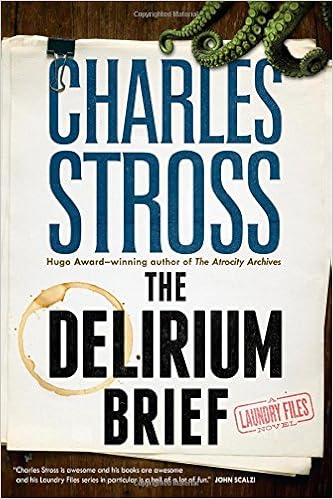
A New Addition to The Laundry Files: The Delirium Brief

Bob Howard (not his real name) has overcome a lot of things in the course of his work for the British government’s secret occult services agency, the Laundry. From a magic-wielding sect of modern SS revivalists, to fiendish mind-controlling cosmetics makers, to a demon-driven televangelist with designs on world power, Howard has faced down threats to human civilization. He’s also faced your garden variety zombies, vampires, and even the occasional unicorn (trust me, they’re a lot nastier than you think). He’s managed to do it while keeping his paperwork in order, navigating the complexities of a modern bureaucracy, and only sort of losing his soul.

In the Laundry Files novels, the British author Charles Stross has created world that is an entertaining mix of Jim Butcher’s Dresden Files books and the George Smiley novels by John LeCarré. To stay interesting over the course of a number of volumes, a series needs a good hook. Stross’s is his knowledge of life in the world of offices. You might think this would be dull, but his mastery of the lingo of the corporate world, from deliverables to leaning in to the muppet shuffle, gives his books a combination of bite and comic flavor. Stross adds to this an ability to riff on other writers in ways that give his books depth and variety. From Lovecraft to Tolkien, from Flemming to Deighton to Anthony Price, Stross has digested a wide range of writers and genres. The result is a narrative in which each new story is fresh and compelling.

At the center of it all is Bob Howard, the model of the sort of resigned yet determined British civil servant that has kept the island running since the end of the Second World War. Like many of the lower level operatives of the Laundry, Howard stumbled into the job. In the world of the Laundry Files, magic is a form of mathematics and doing the wrong formula, algorithm, or computer program can open the world up to the sort of eldritch horrors from beyond space and time that Lovecraft was fond of describing. In graduate school, Howard wrote a program that nearly summoned a malevolent major deity. After that, the Laundry made him an offer he couldn't refuse.

The last two novels in the Laundry Files have gone a little off model. In The Annihilation Score (2015), the main character is Howard’s wife, Dr. Dominique “Mo” O’Brien, another forcible inductee to the Laundry. It was not one of my favorites in the series, although it had some interesting plot points related to the ability of middle-aged women to become invisible (or to be rendered invisible by the male gaze). The Nightmare Stacks (2016) centered on another character entirely, and while it had a pretty entertaining take on Tolkien and elves, it didn't quite work for me in the way that some of the earlier ones did. I must admit to having been a bit worried about where this was all going.

The Delirium Brief, which was released just this week, brings it all together in a way that makes the previous books more interesting but also tells a compelling story in its own right. Stross brings back one of my most/least favorite villains, the demonically possessed televangelist Raymond Schiller. When last we left Schiller, he was trapped on a dead alien world after his failed attempt to raise a demonic entity known only as The Sleeper in the Temple. Now he’s back, and attempting a hostile takeover of the British government. Meanwhile, the Laundry is in crisis. The events of The Nightmare Stacks (only three months previous) left a significant body count and a swathe of destruction in the center of Leeds (neither one of which is good news for a secret government agency). Bob Howard and his fellow civil servants are faced with one of those “lesser of two evils” choices as their agency is privatized out of existence and the end of the world looms.

I originally thought of writing that this book was a return to good form for this series. But after thinking about it, I decided that it’s better than that. The Delirium Brief is an excellent book on its own merits. But, over and above that, it has the quality of making other books in the series better. If you’ve ever dreamed of saving this world, or if you’ve ever sat in a meeting that you thought was being run by a brain eating alien, Charles Stross’s Laundry Files series has a lot to offer.

~John F.

Tuesday, October 18, 2016

What I Talk About When I Talk About Running by Haruki Murakami

Haruki Murakami, What I Talk About When I Talk About Running  895.635 Murakami

Earlier this month I found myself standing around on a sunny Labor Day morning at the Cuyahoga Fairgrounds, listening to German pop music and watching guys in lederhosen circulate through a crowd of people in running gear. I was going to run in the Cleveland Oktoberfest 5K, the first time I’d done something like that in…well…a very long time.

I used to do a lot of this sort of thing when I was in high school, but then I got more into team sports (first soccer, then rugby in college, competitive cycling, then soccer again). I’m used to having a bunch of teammates around me. But here I was, alone and trying to figure out how I was going to find my way through this thing. The starter called us to the line. I stood there, waiting for the gun in a crowd of strangers. And at that moment I was struck by a realization: this is exactly where I am supposed to be.

I got back into running about a year ago. It should come as no surprise that, as a librarian, I am kind of bookish and my normal mode of finding my way through something new is by reading about it. I’d read a few books about training, one or two about diet, and a few about the overall process, but I hadn’t really found anything that caught my imagination. Then one afternoon I was nosing around literary memoirs here at the library and I ran across What I Talk About When I Talk About Running by the Japanese novelist Haruki Murakami. I’ve always loved Murakami’s novels (especially The Great Sheep Chase and The Wind-Up Bird Chronicle). Murakami’s books have a really odd perspective, and I don’t think that it’s just a matter of cultural translation between the Japanese and us. But they’re also humane and beautiful and once I start one I usually can’t put it down.

What I Talk About When I Talk About Running intertwines the story of Murakami’s writing and his running. As in his novels, Murakami has an eye for interesting detail, as when he relates the story of deciding to write his first novel while lounging around the outfield bleachers at a Yakult Swallows game in 1978. For Murakami the process of becoming a novelist and that of becoming a runner had some important similarities. In both cases it took him a while before he realized that he was going to get serious about it. In both cases he was extraordinarily successful, becoming a world famous novelist and getting himself the point that he could run marathons (which only a relatively small proportion of runners ever do).

Wednesday, August 24, 2016

Like a Prayer: a Review of My Best Friend's Exorcism

Did you ever huddle up with a group of friends watching The Exorcist in the middle of the night because you knew your parents wouldn’t let you see it otherwise? Yeah, I did too. Do you remember staying up way too late eating junk food and singing pop songs into your hairbrush? If you put those things together, you get an approximate feel for Grady Hendrix’s new book, My Best Friend’s Exorcism. It’s an odd, yet enjoyable mix of teenage nostalgia and body horror.

It’s 1988 and best friends Abby Rivers and Gretchen Lang are sophomores at the prestigious Albemarle Academy in Charleston, South Carolina. After a night of skinny dipping gone awry, Gretchen starts acting wrong. At first, it’s small things, things her parents and classmates don’t even notice. She curses; she talks back to her mom. Soon she gets worse and Abby becomes concerned for her best friend’s health and safety. Abby has to find a way to help Gretchen before she can destroy herself and everyone around her.

Hendrix has created a vivid trip down memory lane; you can all but smell the United Colors of Benetton and Aqua Net wafting off the pages. He ends up developing an accurate, yet not exactly subtle, metaphor between adolescence and demonic possession. It’s done so heavily, that about halfway through the book; I thought it could’ve gone either way. (Spoiler – it’s totally a demon).

My favorite part was a school assembly where the students gathered to watch The Lemon Brothers Faith and Fitness Show, which basically boils down to four muscle-bound brothers punching cinder blocks and talking about the power of Christ’s love. It wasn’t until reading that scene did I remember sitting through almost the same exact show in middle school (I think they ripped phone books). I was delighted to learn that not only did I NOT imagine such a presentation, but that similar events are pervasive enough to be included in a book like this.

My main complaint was a non-starting plot thread involving a dilapidated shack, Bell telephone wires, and the body of a missing girl. I thought it had a lot of potential (evil phone company!) and seemed like it was going to play into the conclusion of the story, but it got dropped without ever being mentioned again.

But it’s the strength of the friendship between Abby and Gretchen that really carries the narrative. Even when Gretchen is at her worst, lowest point, Abby still wants to be there for her best friend. Everyone else writes Gretchen off as acting like a psycho, but Abby knows there’s something more going on. I wanted so badly for Abby to be able to save her friend because you could really feel how much they cared for each other. And that’s what friendship is, right? When the chips are down, you stand by one another whether you’re facing homeroom or hellspawn.

Looking for something a little more frightening? Try Your House is on Fire, Your Children All Gone by Stefan Kiesbye.

Want some more 80s horror nostalgia? Check out Stranger Things on Netflix. Minus the scares? Read Eleanor & Park by Rainbow Rowell.

~Meredith

Wednesday, August 3, 2016

Reading Outside My Comfort Zone - Westerns

I took a copy of The Burning Hills by Louis L’Amour off the shelf one night because I needed to pull a quote from any western novel. It didn’t matter which one, I just needed something as an example. I was in the process of reshelving the book when I caught a whiff of its pages, and let me tell you, my response was visceral and immediate. It smelled like a distinguished old professor’s study. A man settles into a leather wing chair in the dimly lit room. He gazes upon his overstuffed bookshelves adorned with bronze busts, while filling a pipe with tobacco he had tucked in the pocket of his elbow patched sweater. 

But back to the actual book, The Burning Hills is the story of Trace Jordan; a man who has found himself in a bad way. After returning to his camp to discover his horses stolen and his partner dead, Jordan seeks revenge. He finds and confronts the man he deemed responsible, but a shootout leaves him wounded. With no other options, Jordan escapes into the Arizona desert, soon losing his way.

Luckily, he’s found by a beautiful sheep herder, Maria Cristina, who nurses him back to health even though it puts her and her brothers in danger. The men who want Jordan dead are on his trail and are determined to finish the job, no matter who gets in their way. Jordan must gather all his strength to ride to safety, but he starts to have doubts about leaving, now that he has grown to love Maria Cristina.

So, how was The Burning Hills? A little racist, a little sexist, but not outside what I was anticipating. I get why westerns are popular. There’s definitely an allure to the sepia tinted nostalgia of the American Frontier. But don’t try to convince me these are anything but manly harlequins. Just because the book has a plain leather-bound cover instead of a heaving bosom doesn’t make them a purveyor of high-minded literature. If you’ve never read a western, I would recommend it. I’m not familiar enough with L’Amour’s bibliography to safely say this is one of his better stories (the man wrote 105 separate works before he died) but it’s a quick read and he’s one of the grandfathers of the genre, so if you are curious about westerns, it’s not a bad place to start.

What else do I recommend? I think the only other western I’ve read was Charles Portis’ True Grit. The book was good, but the Coen brothers’ 2010 film adaptation was excellent and a rare case where the movie is actually better than the book.

~Meredith

Wednesday, July 13, 2016

Reading Outside My Comfort Zone: Room by Emma Donoghue

People who’ve read what I’ve posted on this blog will, I’m sure, have the impression that I don’t read a lot of fiction. As I’ve said in other posts, it’s not because I don’t like it. It’s mostly a matter of having relatively little free time and a pile of non-fiction reading that is more or less compulsory. When I do tuck into fiction I mostly want it to be something not too depressing. So it probably came as a surprise to my co-workers when they discovered that I was reading Emma Donoghue’s Room.

Room tells the story of Jack, a five year old boy who along with his mother (Ma) has spent his entire life imprisoned in a small room by a man called Old Nick. Told from Jack’s perspective, Room tells of the last days of his and Ma’s captivity, of their escape and of their construction (in Ma’s case reconstruction) of human lives outside captivity. In the space of 350 or so pages it manages to be both one of the most devastating and also one of the most uplifting books that I have ever read.

I had gone to see the movie shortly after it was released last year. I spent most of the first 45 minutes curled up in my seat with head in my hands. Brie Larson won an Oscar for her portrayal of Ma and allow me to say that she richly deserved it. How she could get herself into the kind of space to play that character, to say those words and live those experiences, I have a hard time imagining. I could barely watch it. I had the most intense desire to find Old Nick and tune him up properly.

I felt this again as I read Donoghue’s spare and beautiful text, if perhaps less intensely. The book spends a lot of time with Jack’s internal monologue and his struggle to come to terms with the fact that there is an actually existing world outside the confines that he has known all his life. This is, perhaps, the biggest difference between the book and the film. The book gives one a much more intense appreciating for Jack’s doubts as to the reality of anything that exists outside the room.

But thinking about it later (and in the wake of seeing the rest of the film) I realized that this misses and important point. The true glory of this film and of the book, the thing that makes it beautiful and uplifting, is that it tells the story of both Jack and Ma reclaiming agency over their lives. Through years of captivity, Ma retained the fundamental human desire to liberate herself, and she formulated a plan to make it happen. Much of the latter part of the story centers on her difficulties, both in adapting to her newly recovered freedom, and coping with her guilt at having been imprisoned in the first place.

The fundamental point here is that it’s her that’s doing it. She has the will to survive and to protect he son as best she can. She plans her escape and makes it happen. She acts to reclaim the full measure of her humanity. Perhaps the hardest thing about reading this book for me was resisting the temptation to make myself the hero or the avenger.

I recommend this book. But I recommend that you get it from the library. It is an intense and challenging examination of the power of human beings to overcome trauma. It was well worth reading, but I simply cannot imagine anyone wanting to read it more than once.

~John F.

Thursday, June 30, 2016

Series Review: The 5th Wave

Now that Rick Yancey has completed his trilogy The 5th Wave, and so have I, I wanted to do a quick review of the series as a whole, while also trying not to spoil it for any of you who have not read this series at all yet. (What are you waiting for?)

The 5th Wave
I have booktalked this book to death with the teens (and some adults) at my library. It was gripping, scary, and yet in some way relateable. Cassie Sullivan is a teenage girl struggling to stay alive and save her baby brother in the midst of an alien war. What I loved about this concept was that the aliens were not tentacled green monsters (or anything similar). In fact, they were mostly not present in the book; those that were present looked like regular people, but were emotionless and much more sinister than your average human. I also liked the jumps between character perspectives, which gave me a fuller picture of what was happening in different parts of the world created in this book. We jump between Cassie and some other teen and child characters, learning about their experiences as the "war" progresses.

The Infinite Sea
Continuing our tale where the last book left off (and without giving much away), this book followed much of the same pattern as the previous book, but mixed up who the narrators were. We were able to see into the heads of some of the more secondary characters from the previous story, learning their pre-alien infest backstories and how they got to where they are, as well as catching up with Cassie and the other characters we got to know in the first novel. After the characters have escaped certain death in the first book, they have largely been separated and are trying to survive the harsh conditions on Earth. This second book was very good, but it felt like the "middle," meaning that it was pretty clear we were in some ways just biding time until the last story. Some of this book also took me out of the realm of realism (as much as there can be in an alien infestation story) and into the realm of fantasy, which wasn't super ideal to me. I'm picky like that.

The Last Star
This last book in the series was action-packed. There were so many different fight scenes and near-death experiences over the course of this story. Continuing where we left off in The Infinite Sea, the characters are on the clock before something big and bad happens. (No, I'm not spoiling it!) The fact that there's a clock ticking makes this whole story very intense, keeping you on the edge of your seat and very aware of how much time is left. I wanted the ending to be a little different, but it worked.

Overall:
Put all together, I really have to commend Rick Yancey for the amazing world-building he created. The books left me constantly questioning what I knew, tricking me along with the characters. There were a lot of ups and downs and quite a bit of blood and death. In that way, the books would make good readalikes for fans of The Hunger Games and Divergent. I also really appreciated the fact that Yancey never let us forget that these were children (characters aged 5-19ish) and how that would impact kids on their own in a treacherous world. The concept reminded me a lot of the zombie stories that have been oh so popular in the last five years or so, especially considering the kids are constantly on the move in abandoned places, foraging for survival. But with more guns.

I very much recommend this series, even if you aren't a fan of alien books. When I grabbed the first book, I didn't realize the premise was alien-based. Honestly, had I known that I probably would not have read the series, and that would have been quite a shame, since I really enjoyed these books. They kept me on the edge of my seat, made me laugh, made me cry, made me have existential crises, etc. So, give it a shot. Also, if you are an audiobook listener, these were excellent on audio. Some of the best I've ever listened to.

~Cailey

PS-I did see the movie out earlier this year and yes, the book was better. The movie was not terrible though.

Tuesday, June 7, 2016

Reading Outside of My Comfort Zone…Kind Of

I am a little embarrassed to admit that I am very new to the graphic novel/comic book game. My husband is a comic reader and many of my co-workers are as well, but I just hadn’t given them a shot until recently. Being so new to this format, I thought I should start with something I know. Joe Hill is one of my favorite authors and I have loved all of his novels. Lucky for me, he also writes comic books.

Hill’s first comic series was Locke and Key and the first issue was released in 2008. After a horrible tragedy, the Locke family moves to Lovecraft, Massachusetts to the Keyhouse mansion that has been in their family for centuries. The Locke children quickly learn that there are some evil forces at work within the house. Bode, the youngest, starts encountering keys with special powers, most of which are terrifying (like a key that literally unlocks your head and gives others access to your thoughts and memories). With these keys, the Locke children begin to unfold a story from their father's past that will have very real consequences in the present day. They are forced to fight the evil that they unintentionally released.

These stories are not for the faint of heart. There is a lot of violence and a lot of gore. But there is also a lot of heart to the story. You quickly become very attached to the Locke kids, especially Bode, and you root for their victory over the terrible evil that resides in Keyhouse. It has been rumored that there is a TV series based on Locke and Key in the works, and I for one think that is a great idea. I thoroughly enjoyed this series and it has convinced me to continue reading stories in this format. From what I hear, there are a lot of amazing ones out there. 


Have you read anything outside of your comfort zone lately?

~Ragan S.

Thursday, May 5, 2016

Chick Lit Month

https://internationalchicklitmonth.com/

In honor of Chick Lit Month I'd like to celebrate the under-appreciated genre with some of my favorite chick lit books. Now, chick lit generally just means books that are aimed at a primarily female audience. Urban Dictionary even says so: "Slang for a genre of literature geared towards female readers , which deal with modern issues in women's lives." Many people assume it is just romance, but it also includes books dealing with families, friends, coming of age, etc. Okay, lesson over. 

My favorite chick lit books tend to feature romance because I am a mushy type person. For the sake of variety I'll try to mix it up here. 

Bet Me by Jennifer Crusie

My all time top favorite chick lit writer is Jennifer Crusie (who does not write nearly enough books!). Of all of her books, this one is my favorite romance. The book is a pretty traditional romance at first glance, but it is just so well-written that I give it major props. 

Min is a woman in her thirties who knows what she wants in life, but is constantly bowing down to what her mother wants for her. That's how she wound up with her cold fish of a date the night she meets Cal. Min gets dumped (and doesn't really seem to care so much) and is out with her friends at a local bar. 

Cut to Cal. Cal is a hotshot entrepreneur out with his friends at the same bar. Cal is not into serious relationships, much more into flings. He's the betting type, constantly making trivial bets for the thrill of it with his buddies. This is where he gets into trouble. David, the man who just dumped Min, bets Cal that he can't get Min to go out with him. Of course, this bet isn't really above board since David knows Min was just dumped and sincerely doubts she'll say yes, thus fixing the bet in his favor. 

Since Min is far from the normal woman Cal dates, the two clash quite a bit, but it winds up working for them. After a series of misunderstandings, including funny incidents, the love story comes to fruition. This book features fun shoes, chicken marsala, lots of bets, and a love of donuts.

This book could totally be a movie, it is so easy to picture what is happening. Crusie is just a great a writer, easy to get sucked into her mix of comedy and drama, and she is great at creating awesome characters. Granted, this book is a little older, but give me the benefit of the doubt and check it out. 

~Cailey  

Tuesday, April 12, 2016

Marked in Flesh: A Review

At the beginning of March, I was awaiting the publication of Marked In Flesh by Anne Bishop. Marked in Flesh is the fourth installment in The Others series.

A short summary of the series: Humans are not the dominant species on earth, the Others are… and the Others have been known to eat a human or two when annoyed. When the Others meet human Blood Prophet, Meg Corbyn, who is on the run from the humans keeping her in Benevolent Ownership (i.e. legalized slavery) everything changes.

When the first Others book, Written in Red, came out in 2013, I loved, loved, loved it and gave it my first five star rating. Books two and three were good, but not as good as book one. So, while I anticipated that Marked in Flesh would be a good read, I wasn’t foaming at the mouth for it.

But, once Marked in Flesh was released, I devoured the book. After I finished, I thought, “Well, that was really good. I think I should go back and read the first one again.” So, I did… and book two… and book three.

OMG. The entire series is better when it is reread. The plotting behind the action is so well thought out; it flows over all four books. Lines that I thought were simple flavor are actually foreshadowing to books and events in the rest of the series. Anne Bishop must have a massive plan and outline plotting the storyline for the entirety of this series.

Added to that, each book in the series is just plain well written. The characters are engaging. The reader actually begins to root for the Others – who eat humans and are considering wiping human civilization from the continent. The slow-burning romance is sweet and is masterfully done. And each book is entertaining (although I will say that one and four are better than two and three).

I love this series.

So, now I AM foaming at the mouth in anticipation of book five… which should be coming out sometime next year… and all I can say is “Write faster, Anne Bishop. Write faster.”

~Mary P.

Tuesday, April 5, 2016

The Reckoners Series: A Review

My last contribution to this blog was about my first encounter with Brandon Sanderson’s work, which occurred after I selected The Rithmatist for a meeting of MPL’s Teen Book Club. I was so enthralled by Sanderson’s writing that I binge-read three of his books last month; and after reading April’s book club selection, I began a fourth.

That’s just how I am—when I discover something new that I really enjoy, I obsess over it. For example, a couple years ago I was browsing Netflix and started a Charlie Chaplin film on a whim. Next thing I knew, I was completely fascinated by the man. I couldn’t watch his films or read his biographies fast enough. I tried to subtly persuade my husband to get me an original 1931 poster for City Lights that I found at a local antique shop for Christmas. Yes, it was expensive—I could never justify purchasing it for myself, so it had to be a gift—and, no, we didn’t have anywhere to put it, but that didn’t stop me from walking past it a hundred times, dreaming.

This time around, my obsession became Brandon Sanderson’s writing, which flows so naturally that it feels effortless. He makes writing well seem easy, which is truly the mark of a master talent. As mentioned above, I read three of his books last month—specifically, the Reckoners trilogy.

The first book in this series is Steelheart. Here, Sanderson demonstrates his masterful world-building prowess and introduces an intriguing cast of characters. Readers are transported to an alternate version of the United States, ten years after a mysterious star appears in the sky, and ordinary people begin to develop superpowers. These superhumans—who come to be known as Epics—don’t have much in common with the superheroes with whom we are familiar, however. In fact, most Epics have a decidedly evil streak, overthrowing civilization as we know it and lording over cities as kings and queens.   

The story is about David Charleston’s quest to avenge his father’s murder by the titular Steelheart, widely considered to be the most powerful Epic in existence. Ever since he was orphaned at the age of eight, David has studied Epics and the Reckoners—a clandestine group of rebel assassins. More than anything, David wishes to join their ranks. When he discovers that the Reckoners’ next target is in his hometown, he devises a way to introduce himself. They’re the only ones who can possibly help him take down Steelheart once and for all.

What follows is a fast-paced plot that is as fun as it is suspenseful. While it may be a bit too violent for some, I would recommend Steelheart to anyone who enjoys a good action movie. Sanderson’s writing is so visually expressive that I often lost myself in the imagery. To this day, I can picture certain scenes as if I saw them on the big screen.

The other books in the trilogy are also very good reads. Firefight adds to the Epic mythos, answering some questions while simultaneously introducing a greater mystery. The final book, Calamity, gives readers an unexpected and completely satisfying conclusion, which is an uncommon feat for YA dystopian series (I’m looking at you, Divergent). If you are like me and get to the end wishing for more, don’t give up hope—Sanderson stated recently that his next series will take place in the same universe as the Reckoners! 

Usually, the novelty of my obsessions wears off after a while. I find myself back where I started, more or less the same as before… until my next obsession comes along, that is. After a month of Sanderson, however, I can tell that my obsession with his writing isn’t just a phase. My next undertaking is going to be his highly acclaimed Mistborn series. I predict that I will enjoy it so much that I will feel compelled to write another blog entry about it. Only time will tell!

Have you ever enjoyed a book or series so much that you binge-read it in a short span of time? What are your literary obsessions? Let us know in the comments below!

~Ariel


Mentor Public Library’s Teen Book Club is open to teens in grades 9 to 12. The club meets on the first Saturday of every month, from 2:00 to 3:30 PM at our Mentor-on-the-Lake Branch. At our next meeting on May 7, 2016, we will be discussing I’ll Give You the Sun by Jandy Nelson. Copies of selected books are available at the Lake Branch on a first-come, first-served basis. Registration is requested. Call 440-257-2512 with questions.

Tuesday, March 1, 2016

The Rithmatist: A Review

Brandon Sanderson could easily win a spot in the Top Ten Greatest Fantasy Authors of All Time. That’s why I am kind of ashamed to admit that I never read any of his books. It just seems wrong for someone who claims to be a fantasy aficionado to have ignored such an esteemed author!

The good news is that I no longer need to feel guilty about it. I recently finished reading The Rithmatist, which I selected as the Teen Book Club’s book for March 2016. First published in 2013, it is Sanderson’s debut into the wild world of YA literature.


The protagonist of the story is Joel, a 16 year old who is fascinated by Rithmatics, a calculated magic based on geometry, and the Rithmatists who channel it through chalk by drawing one of four known Rithmatic Lines, each of which have special powers. Needless to say, it’s a pretty unique system of magic—much different from the sparkly, wizardy stuff that typically comes to mind. Joel attends Armedius Academy on scholarship and desperately desires to be a Rithmatist. However, Rithmatists are chosen by The Master (a.k.a. God) when they are 8 years old, and Joel’s opportunity was impeded by a familial tragedy. He thus applies himself half-heartedly to his studies, thinking his true calling and passion are beyond his grasp.

During summer vacation, Joel gets the chance to study—but not practice—Rithmatics with the timid, yet brilliant Professor Fitch. Here he meets Fitch’s remedial tutee Melody, a spunky Rithmatist of little aptitude on the brink of expulsion. Yes, it’s the common YA trope:  boy meets girl, and a friendship blossoms despite their initial mutual dislike of each other. I liked seeing Joel and Melody’s friendship grow throughout the book. It felt natural, and I really respect Sanderson for resisting the temptation to make their relationship romantic. That happens too often and too quickly in a lot of YA books, so this was a refreshing change of pace. Of course, I wouldn’t be opposed to this possibility in future installments… 


Anyway… Young Rithmatists begin disappearing; Fitch, Joel, and Melody find themselves in the middle of the investigation. All that’s left at the crime scenes are the chalky remnants of Rithmatic duels and trace amounts of blood—evidence that the students were ambushed and forced to defend themselves. Were they kidnapped? Or worse? Strange chalk drawings near the crime scenes provide another puzzle for our heroes: could there be undiscovered Rithmatic Lines, and if so…what do they do?


I found the investigation aspect of the plot to be so-so. Obviously, there needs to be speculation for this type of story to work, but I felt like the characters (and thus readers) weren’t given a lot of new information over the course of the investigation. They(/I) continued to have the same questions, without really being given much new information as events transpired. The plot could also have benefited from a bit more excitement, as there was little to no action until the climax.

That being said, this is the first time a mystery novel successfully pulled off a bait-and-switch on me. Seriously. Sanderson led me to the wrong conclusion, tricked me into thinking I was correct, pulled the rug out from under my feet, and made me kick myself for not seeing the truth all along. If that’s not what a mystery book is supposed to do, then I clearly don’t know anything about the mystery genre.

Overall, I thought The Rithmatist was delightful. Honestly, I didn’t even talk about half of all the things I found compelling about it in this review. With a mild steampunk flair and clever hints at what I can only describe as a “post-dystopian” setting, The Rithmatist is an entertaining fantasy-mystery hybrid. I am eager to learn more about the characters and the world in the promised sequel, which is anticipated to be released in 2017.

Uh oh… Now that I have read a bit of Sanderson’s work and enjoyed it so much, I can feel that guilt creeping back into my mind. I better get to work on one of his other series, stat!

~Ariel


The Teen Book Club meets the first Saturday of the month at the Mentor-on-the-Lake Branch of the library. Attendees must be in grades 9-12 and can pick up the monthly books at the library.

Tuesday, December 1, 2015

The Storied Life of A.J. Fikry: a review

I read The Storied Life of A.J. Fikry by Gabrielle Zevin over a year ago and really enjoyed it. Recently, my book club read this book as well. Again, I really liked the book, but I find it really difficult to explain why. It's one of those books that just gives you that warm, nice, "can't put it down" kind of feeling. It's just lovely. Since books like this don't come along too often for me, I felt the need to share.

There are very few books out there like this one. A lot of books have characters who are book lovers, or the book is set in a bookstore or library. Obviously, being a librarian, I tend to enjoy these types of books. Lucky for me, they are in abundance. However, very few books have characters quite as opinionated as A.J., who is truly one of a kind. Being a book person (that is a person who loves books, not one who is comprised of them), I really love seeing picky readers, and boy is A.J. picky. At one point early on in the story, he chooses to list the things he does not like in books rather than list what he likes. (This is where the book hooked me in fact.)

Onto the story description: A.J. Fikry is an assertive, depressed, widowed bookstore owner on a tiny island in New England. When we come to know him, A.J. is one of those crotchety old men who hates everything and everyone, spends his evenings drinking himself to death, and basically scares off anyone who tries to help. However, he's only 39, too young to have given up on life. A.J. was dealt a bad hand though. He'd moved to the island to be with his late wife and open his bookstore, but when she was killed, he was then physically and emotionally isolated. It wasn't until another major loss occurred that A.J. started to turn everything around.

When A.J. finally starts to get his life together again, he returns to his store to find that someone has left him something very strange that will change his life forever. The book then follows his journey as he changes and grows over the next 13 years or so. There's a lot that happens: death, love, and secrets! (And that's all I'll say about the plot. Go read it!)

Over the course of the book, we get to know not only A.J., but also the different people who involve themselves in his life: the police chief for the island, A.J.'s sister-in-law, a little girl at the bookstore, and a representative from a small publishing house. These different perspectives not only add depth to the book, but also to the character of A.J., who is complex and grumpy, but lovable.

The book was reminiscent of a fairy tale to me. Things happen to A.J. that seem like happenstance, but are truly fate. Even when A.J. is at his worst, somehow, his life turns around and it turns out that some good has come from it. Everything in this book feels fated, and things just seem to work out in the end in a way that makes it seem like that is where we were heading the whole time. It's a difficult this to explain, but the whole book is kind of a puzzle, always meant to fit the way it does.

I very much enjoyed this book, and this was my second read-through. I recommend it to people who love books and talking books. Even though some not-so-nice stuff happens over the course of the book (as in life) it still is just a sweet, nice read, in my opinion.

Go on now. Read it!

~Cailey W.

Thursday, October 1, 2015

Mindy Kaling's New Fabulous Read

By now, I'm sure all of you know that Mindy Kaling's new book Why Not Me? is out. It was an awesome read. Of course, I am a dedicated fan to Ms. Kaling, sticking with her show The Mindy Project from its beginnings on FOX to the recent shift to Hulu. I also loved her on The Office. So I am not impartial.

Mindy Kaling, if you are not familiar, is a writer/producer/actress, best known for her work on The Office and The Mindy Project. She won an Emmy for her work on The Office and works her butt off on everything she works on. I was really looking forward to this book because I enjoyed her last book, Is Everyone Hanging Out Without Me? and I have been mildly obsessed with her show and her person. In fact, I somewhat stalked the hold shelf until I could get a copy (I was first in line, of course).

Why Not Me? is a collection of essays about Mindy's life (we're on a first-name basis now). She covers very important topics such as her writing, her style, her dreams, her fears, her dating life, and a short story about an alternate-universe Mindy that I would totally read as a full-fledged novel. In short, the book covers a lot of ground. It's at times serious, but mostly it is just entertaining and funny. She reveals a lot about her career and how she got there, without too much overlap to her previous book. I would say if you haven't read her first book that it would be beneficial to do so before reading this one, if only so you know more of her background. Whereas her first book was all about her rise to fame, including her childhood and young adulthood, this book pretty much picks up time-wise where the last left off. She discusses the development of The Mindy Project and the ups and downs with that, as well as some peeks into her life, like when she met the president and sort-of dated one of his inner circle.

What I loved about this book was the brevity of it. I don't mean to say that it's super short, but that the book read quite quickly for me. Her essays aren't too long and it was easy to read an essay in each sitting, coming back to it for another as soon as possible. I also like the fact that she is a very relatable person. (And yes, I realize that it's cliche to say that a famous person is "just like us!") There's a chapter where Mindy discusses her average day (with pictures!). It starts out with her not wanting to get out of bed, sitting in traffic, and working herself to the bone all day, not returning home until more than 12 hours later. I can totally relate to that. She makes being famous look harder than you'd think it would be.

Mindy has a great attitude about life and love, with only a few moments of "why me" spread throughout to make her look reasonably human. I'd say her ideal audience is me: young women in their 20s or 30s who are familiar with her work. However, I feel like there is something for everyone in this entertaining memoir-ish read.

Some similar reads:
Is Everyone Hanging Out Without Me? (and other concerns) by Mindy Kaling, 2011
Bossypants by Tina Fey (why haven't you read this yet?)
Yes, Please by Amy Poehler
Seriously...I'm Kidding by Ellen DeGeneres

~Cailey

Tuesday, September 22, 2015

All the Light We Cannot See: an honest review

What else can be said about a novel that has garnered rave reviews from most major publications and won a Pulitzer Prize? How about this: what an absolute load of junk. In fact, All the Light We Cannot See by Anthony Doerr was such an unsatisfying novel that it’s making me irrationally angry just thinking about it. I wasn’t even planning on writing a review of it, but when I woke up in the middle of the night and decided to finish the last 100 pages or so the ending left me so annoyed that I’m writing this from my home at 5 o’clock in the morning.

So what happened? Well, All the Light We Cannot See tells the parallel stories of Werner Pfennig and Marie-Laure LeBlanc. The “present” of the novel takes place in 1944 when Werner and Marie-Laure are both holed up in the walled city of Saint-Malo during a stretch of allied bombing. The story flashes back to 1934, recounting their childhoods (Werner spends the most of his either in an orphanage or a Nazi military academy, Marie-Laure spends hers in hiding) and slowly picks its way forward, toward their inevitable meeting in 1944. There’s also a rare gem (which may or may not be cursed) Marie-Laure’s father was given possession of from the museum he worked at and a German officer determined to locate the treasure before his tumors kill him. Doerr occasionally shifts the narrative back to 1944 to check in with their present selves and to inch Werner and Marie-Laure closer together.

Mostly, the time jumps are minimal and easy to follow – we’re hardly talking Kate Atkinson’s Life After Life in terms of chronology I could barely keep up with. In fact, I rather enjoyed the first three or four hundred pages (at first), even if the characters were flat and static. Here – I can describe them for you right now. Werner: white hair, small for his age, likes to build radios. Marie-Laure: blind, likes Jules Verne, wants to go outside. That’s it. They never progress beyond those initial features. In fact, their convergence was so fleeting and pointless; I basically read the last 100 pages in shock, not willing to believe that was it – my rage growing with every turn of the page. I think that’s my biggest gripe with the novel. The little action the characters were involved with seemed so empty because I didn’t feel like I knew them well enough to understand the choices they made. It was like watching two people from a great distance. I could see their movements, but didn’t really have any explanation for it.

All the Light We Cannot See isn’t the first Pulitzer Prize winning novel in recent memory that has valued structure over story (Richard Russo’s Empire Falls and Elizabeth Strout’s Olive Kitteridge both spring to mind as examples of this). They mask paper thin characters and incomplete story behind the guise of disjointed narrative and call it “Literary Fiction.”

Not a single event in All the Light We Cannot See was concluded in any satisfying way. What happened to Marie-Laure’s father? Arrested in 1941 and the
n all trace of him was lost. Where did the gem go? It’s somewhere, I guess. What’s the deal with Werner’s sister Jutta? I have no idea. We spend zero time with her only to have her character close out the novel. 

The only praise I can give this book is that if Doerr was attempting to capture the ultimately meaninglessness of life, he did so spectacularly. 

My recommendation – life is short, do yourself a favor and watch Mad Max: Fury Road instead.

~Meredith T.

Tuesday, August 18, 2015

Saint Anything: A Review

Saint Anything is the newest book by YA author Sarah Dessen. Dessen now has 11 books to her name. While not John Green, she has her own following of devoted readers, myself included. I first discovered her as a teen myself, and began reading her stories in earnest. More than ten years later, I still look forward to her new releases. Her books always involve romance, but they are deeper than that. The teens in her books are always dealing with some sort of difficult drama or trauma. For example, in past books, her characters have dealt with sexual assault, drug abuse, parental abandonment, the trauma of relocation, loss, and dramatic weight loss (among other things). What I find remarkable about her stories is that despite the somewhat heavy nature of whatever topic is being covered, her books are easy to relate to and very real.

Saint Anything is the story of Sydney, all around good girl. She goes to a fancy private school, gets decent grades, listens to her parents, and is just a responsible kid. She always has been. Living in the shadow of her older brother Peyton, Sydney has always been the opposite of him. Where Peyton is daring, Sydney is safe. She just doesn't take risks, since she's seen how they have worked out for her brother.

Peyton is trouble. Not just in trouble, but trouble all around. His parents have tried everything to keep him out of trouble, but again and again, he messes up. This time there is no easy solution. After minor infractions for drugs and break ins, Peyton got behind the wheel drunk. The family's lives will never be the same. This is where the book starts out.

Sydney switches schools to gain a new identity after being the kid whose brother's in prison. She starts off at the local public high school feeling lonely and invisible. It's not a new feeling for her, since that's how she feels at home too. Her parents' lives, in particular her mother's, revolve around Peyton. They barely notice her as long as she is where she is supposed to be on time. It's not until Sydney meets the Chathams, Layla and Mac, that things begin to change for her. She finally has real friends she feels comfortable opening up to, and she has a place. All of her new friends see her, and it helps Sydney see herself outside of her family.

This book is a very self-aware type of novel. A lot of the book is just Sydney trying to figure out who she is--in her family, in school, in her group of friends, in relation to her brother. After so much change in her world in the last few years, Sydney seems to have lost herself. Over the course of the novel, she comes to terms with a lot, while still leaving work in some other areas. (Side note-I like when an author doesn't tie up the novel neatly: that's not real to me.)

The book deals with some difficult issues, but it handles them very well. Dessen hasn't lost her touch. She's an excellent writer and character developer (is that a thing? Let's say it is.). I love the way she crafts details into the characters, even secondary characters, without being too overwhelming or making the book feel like it's dragging. Despite the fact that Sydney is dealing with some very particular issues that many teens (or adults) may never experience, Dessen manages to make the story easy to relate to, with problems many teens will and do face regularly. Plus, the characters are likable, and the story is just plain good.

This book was a bit different than her others, most notably that it did not take place during the summer, which most of her previous books do. When I think summer reads, I tend to think of Sarah Dessen's books. Oh, hey! It's still summer! Perhaps you should pick her books up yourself. Just saying.

Some similar reads:
Anything else by Dessen. My favorites include Along for the Ride and Keeping the Moon.

Some other realistic fiction authors with romance:
Susane Colasanti 
Deb Caletti

~Cailey

Thursday, July 30, 2015

Go Set a Watchman: A Review

I burned through the new Harper Lee novel Go Set a Watchman in the last couple of days. It was a depressing read, albeit not for the reasons that a lot of people will find it depressing. This is probably the biggest literary event that most of us will experience in our lifetimes. Looked at in its larger context there are some things about it that seem, at least to those observing from distance, to be a bit unseemly (Joe Nocera had an interesting piece on this in the New York Times a few days ago). Without access to the principles, it’s difficult to know exactly what the circumstances of the release of Go Set a Watchman really are. But what is clear is that the differences in the character of Atticus Finch between Go Set a Watchman and To Kill a Mockingbird are (and will continue to be) very upsetting to a lot of people.

Unlike a very large proportion of the high school students of my generation, I didn’t read To Kill a Mockingbird in school. My crotchety old high school English teacher, Mr. Patterson, had us read Faulkner’s Intruder in the Dust instead. The stories are similar in a lot of respects, as are the underlying issues. Personally I think Intruder in the Dust is a better book, but I certainly respect the views of those who think otherwise. Perhaps if I’d read To Kill a Mockingbird in adolescence, as opposed to in my cynical twenties, I might feel differently.

What I do understand is the attractiveness of Atticus Finch’s heroic qualities, especially when viewed against the backdrop of the grim state of race relations in the United States around the time that To Kill a Mockingbird was published. There were a lot of people in America in the 1960s who were hungry to hear someone in the southern milieu speak out for the values of the freedom and equality that the Constitution promised to all, and for which a lot of blood had been spilled since 1861. Atticus Finch’s powerful speech in defense of those values was moving and enshrined him in the hearts of millions of Americans as a defender of something fundamentally right about the nation.

As most people are now aware, the version of Atticus Finch that appears in Go Set a Watchman is, at least apparently, cut from different cloth than his earlier incarnation. In particular, his is an ardent and unrepentant segregationist. This is a hard thing for fans of the earlier version to swallow, even if it is the case that those views are (historically speaking) not out of place, nor is it unheard of for people’s views to change or harden as they reach old age. It is also worth mentioning that the writing in Go Set a Watchman is not nearly so precise and polished as that in To Kill a Mockingbird. The overall effect of the release of Go Set a Watchman is hardly likely to be an enhancement of Harper Lee’s reputation, which is another unfortunate dimension to this story.

In the New York Times article mentioned above, Joe Nocera essentially suggests that Go Set a Watchman is best viewed not as a prequel to To Kill a Mockingbird but rather as an early draft. This interpretation has some problems, not the least of which is that Go Set a Watchman has many of the qualities of a free standing novel and doesn’t share a lot with the later book. Still, I think it’s an approach that has merit, both in terms of making sense of Harper Lee’s statements about her propensity to revise and polish, as well as in terms of the final product.


As I said, I don’t have quite the degree of emotional connection with Atticus Finch as some people I know. But I (and any other lover of Tolkien’s work who has seen Christopher Jackson’s defilement of The Hobbit) do understand what it’s like to have a treasured literary memory of youth dragged through the mud. Reading Go Set a Watchman as something like a first draft, problematic as it is, at least allows one to preserve the character of Atticus Finch in the power and the glory of his original incarnation. Go Set a Watchman is definitely worth reading, but it’s a book that needs to be read the right way. 

~John F.